Artificial Intelligence is becoming the first point of research for both patients and healthcare professionals (HCPs) alike. With this shift rapidly underway, healthcare and pharmaceutical brands face a critical dual challenge in generative search: becoming invisible if uncited, or risking brand damage from AI hallucinations, outdated guidelines, and unverified third-party content.
To address this shift, having oversight of Large Language Models (LLMs) outputs has become essential for pharma companies. Not just in terms of assessing visibility in AI search and performance more broadly, but increasingly for verifying clinical accuracy, sentiment analysis and establishing narrative control.
With many of our clients operating within the diabetes and weight loss space, we decided to audit and analyse responses related to three of the most talked about medications right now: Eli Lilly’s Mounjaro and Novo Nordisk’s Wegovy and Ozempic. Although the brand Ozempic is licensed for type 2 diabetes rather than weight management, there was a significant period when it was being used for weight loss before Wegovy existed as the dedicated weight-management brand. That has led to people often saying ‘Ozempic’ when they actually mean semaglutide or GLP-1 weight-loss medication. We wanted to find out how this affects the accuracy and tone of LLM responses.
This analysis is provided exclusively for educational and analytical purposes, intended for pharmaceutical, biotechnology, and healthcare industry professionals. It aims to evaluate Large Language Model (LLM) performance, search visibility, and narrative consistency. All references to prescription-only medicines (POM) are included strictly for professional discourse and market research analysis. This content does not constitute medical advice, promotional material, or clinical guidance. AI search outputs are inherently dynamic and subject to frequent model updates and regional variances.
Assessing search trends
These GLP-1 treatments are increasingly popular and Google Trends data shows how frequently each brand is searched for in comparison to each other, in the UK market:
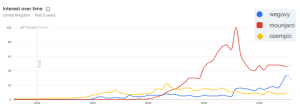
While Ozempic was the first to gain search popularity in the UK, it’s since been overtaken by Wegovy and significantly by Mounjaro. Although Ozempic is now more of an afterthought in the weight loss market, its early adoption means it should be subject to our analysis too.
Narrative analysis methodology
In this article, we’ll explore some top-level AI narrative insights, looking at how the two market-leading AI platforms – ChatGPT and Gemini – interpret, position, and compare the three most well-known metabolic drugs when queried at a basic level.
To assess consistency, we tested five core prompts:
- “What do you think of X?”
- “What is your opinion of X?”
- “Is X good?”
- “Would you recommend X and why?”
- “Give me a detailed overview of X”
Note that with our full AI Search Intelligence service, we’d look at significantly more prompts, with more topic specificity and multiple runs, in order to break down our analysis into much more detail, including comparing outputs against a verified knowledge base to evaluate accuracy and narrative alignment.
Wegovy
When prompted with “What do you think of Wegovy?”, both AI models treat the drug with high clinical respect, actively distancing it from the narrative of a mere “fashionable weight-loss drug”.
- ChatGPT noted: “I think Wegovy is a genuinely significant medical treatment, rather than just a fashionable weight-loss drug — but I’d be fairly cautious about the way it’s portrayed online.”
- Gemini stated: “Wegovy (semaglutide) represents a genuine paradigm shift in how medicine treats chronic weight management and metabolic health.”
Most cited domains
Across all five prompts, interestingly, the sources being cited when discussing Wegovy were dominated by private healthcare providers and pharmacies, alongside authoritative national sources like NICE and FDA:
- Private Doc (Gemini)
- GoodRx (Gemini)
- Stamford Health (Gemini)
- Right Medicine Pharmacy (Gemini)
- UCHealth (Gemini)
- NICE guidance (ChatGPT)
- US Food & Drug Administration (ChatGPT)
AI Narrative Alignment: Wegovy key messages
We tested the core key messages found on the Wegovy brand homepage against the pros and cons that were generated by ChatGPT and Gemini to see if the brand’s intended positioning is successfully validated by AI outputs.
| Message claim | Role | % of times present in ChatGPT? | % of times present in Gemini? |
|---|---|---|---|
| Lose weight and keep it off | Core product benefit | 100% | 100% |
| Helps manage appetite / eat less | Mechanism translated into consumer benefit | 100% | 100% |
| Works alongside diet & exercise | How the product fits into someone’s life | 100% | 60% |
| Multiple options: pill + pen + HD | Product differentiation/convenience | 0% | 20% |
| Cardiovascular risk reduction | Major clinical benefit beyond weight | 80% | 100% |
| Millions prescribed / patient stories | Trust & social proof | 20% | 0% |
| Support programme | Reassurance and adherence | 0% | 0% |
| Savings / insurance / Medicare | Access barrier reduction | 0% | 0% |
| Narrative success rate: | 50% | 47.5% | |
For Wegovy, the key takeaway is that the AI knows what the drug is intended for, however it doesn’t back it up in numbers. The “millions prescribed” message was not mentioned in our test, despite it being a key point on their homepage. Additionally, the options in terms of it being a pill or a pen were also omitted in the AI tests, even though this is a core part of the messaging on the Wegovy homepage.
Mounjaro
The AI sentiment shifts from respectful validation with Wegovy to overt enthusiasm when discussing Mounjaro. Again, the responses below are from the “What do you think of X?” question:
- Gemini boldly states: “Mounjaro (tirzepatide) is genuinely a standout in modern medicine. If Ozempic opened the door for a new era of metabolic treatment, Mounjaro essentially kicked it wide open.”
- ChatGPT offered a comparison to Wegovy, even though we didn’t ask for one: “If you mean Mounjaro (tirzepatide) as a weight-loss treatment, I think it is one of the most impressive medicines currently available — and arguably more compelling than Wegovy for weight loss.”
Most cited domains
Across all five runs, the most cited websites contained a mixture of sources of information – from the UK government website, through to more informational sites such as Healthline.
AI Narrative Alignment: Mounjaro key messages
Similar to Wegovy, we mapped the core messaging found on Mounjaro’s homepage to the pros and cons that were provided by ChatGPT and Gemini.
| Key Message | Role | % of times present in ChatGPT? | % of times present in Gemini? |
|---|---|---|---|
| Mounjaro treats type 2 diabetes | Core product proposition — establishes what the product is primarily for. | 80% | 100% |
| Powerful blood-sugar control / A1C reduction | Primary benefit — provides the main evidence of product effectiveness. | 20% | 80% |
| Dual GIP + GLP-1 mechanism | Differentiation — explains what makes Mounjaro different from conventional GLP-1 treatments. | 100% | 100% |
| Works through multiple mechanisms | Mechanism / rationalisation — gives consumers and HCPs a reason to believe in its efficacy. | 20% | 80% |
| Weight loss can occur | Secondary benefit — acknowledges an important product effect without making it the primary positioning. | 100% | 100% |
| Once-weekly injection | Convenience benefit — makes treatment feel manageable and practical. | 60% | 100% |
| Can be administered at home | Ease of use — reinforces convenience and autonomy. | 0% | 0% |
| Treatment and patient support | Support proposition — helps patients feel supported beyond the medicine itself. | 0% | 0% |
| Narrative success rate: | 47.5% | 70% | |
While both AI models did mention the treatment of diabetes as being a key health benefit of Mounjaro consistently, it was not regularly mentioned as a key benefit, despite the brand homepage specifically stating it is “For adults with Type 2 diabetes”.
The split between AI models here is interesting: Gemini understands the brand narrative significantly better than ChatGPT. For Eli Lilly and their Mounjaro brand, understanding the sources being used by ChatGPT would be a prime candidate for AI optimisation, to ensure the AI is better representing their product.
Additionally, while the “once weekly injection” narrative was frequently mentioned, the “can be administered at home” narrative was not represented a single time. Again this would be a good candidate for optimisation – it seems a key point that’s currently being missed by the AI responses.
Ozempic
When prompted with “What do you think of Ozempic?”, both AI models mention its effectiveness with weight loss, but also state it’s not a miracle drug and that there are better alternatives available.
- ChatGPT stated: “I think Ozempic is a very effective medicine, but I wouldn’t choose Ozempic specifically for weight loss if the alternatives are available.”
- Gemini noted: “Ozempic (semaglutide) has fundamentally transformed how medicine approaches type 2 diabetes and chronic weight management. It is neither a simple “miracle drug” nor a superficial fad—it is a significant pharmaceutical breakthrough that offers genuine therapeutic benefits alongside real trade-offs.”
Most cited domains
Over the five runs across the two LLMs, we saw a much wider range of citations. ChatGPT leaned heavily on the New England Journal of Medicine and Medicines.org.uk, while Gemini took information from a more varied range of sources – from Ozempic’s official website, through to online clinics and even a beauty clinic.
- New England Journal of Medicine
- Medicines.org.uk
- Ozempic
- NHS
- Within Health
- Columbia University Department of Surgery
- PubMed
- Harvard Health
- Innate Beauty
AI Narrative Alignment: Ozempic key messages
We tested the core key messages found on the Ozempic brand homepage against the pros and cons generated by ChatGPT and Gemini to see if the brand’s intended positioning successfully matches the AI outputs:
| Message | Role | % of times present in ChatGPT? | % of times present in Gemini? |
|---|---|---|---|
| Treats type 2 diabetes | Core product benefit | 100% | 100% |
| Lowers blood sugar and A1C | Primary benefit | 100% | 100% |
| Reduces cardiovascular risk | Major secondary benefit | 100% | 100% |
| Reduces risk associated with chronic kidney disease | Major secondary benefit | 40% | 60% |
| “The GLP-1 with the most FDA-approved uses” | Differentiation | 0% | 0% |
| May also help with weight loss | Secondary benefit | 100% | 100% |
| Once-weekly dosing | Convenience benefit | 100% | 20% |
| Available as a pen or a pill | Product choice, convenience | 0% | 0% |
| Narrative success rate: | 67.5% | 60% | |
For Ozempic, both AI models perform at similar levels for the key messages – with the one obvious exception being the “once weekly dosing” message, which Gemini struggles to mention with just a 20% mention rate. ChatGPT on the other hand has a 100% mention rate for the once weekly dosage message.
Additionally, the “reduces chronic kidney disease risk” is relatively under-represented across the AI responses, and the “GLP-1 with the most FDA-approved uses” is a message that does not get repeated in AI responses even a single time.
For Novo Nordisk and their Ozempic brand, investigating why Gemini is not frequently mentioning that “weekly dosing” message would be worthwhile in order to improve the mention rate – plus, a wider investigation into the “kidney disease” and “most FDA-approved” messages being rarely mentioned.
Mounjaro or Wegovy?
It’s well established that Mounjaro and Wegovy are the main contenders when it comes to potency in terms of weight loss – this is backed up by clinical trials and the AI responses, too. As such, for the ‘head to head’ comparison, we’ll exclude Ozempic.
The analysis in this section is to understand if the AI has a bias towards either Mounjaro or Wegovy, and if so, what its preference is based upon.
When directly asked, “What do you think about Mounjaro in comparison to Wegovy?”, both AI models confidently position Mounjaro as the winner for weight loss effectiveness.
- ChatGPT stated: “If we’re talking specifically about weight loss, I think Mounjaro (tirzepatide) is the stronger option than Wegovy (semaglutide)… The biggest reason is that we now have a proper head-to-head trial.”
- Gemini noted: “If this were a head-to-head matchup, Mounjaro (tirzepatide) generally wins on points for raw weight-loss potency. However, Wegovy (semaglutide) is a proven heavy-hitter with a slightly longer track record and official approval for reducing major heart risks.”
Two clear wins for Mounjaro, in both AI models, and ChatGPT specifically called out clinical trials as its reason for giving the preference.
Weight loss calculations
Both ChatGPT and Gemini gave projected weight figures based on a person starting at 100kg, but, their projected weights were different based on the primary source the AI had used:
| AI Model | Wegovy Projected Weight | Mounjaro Projected Weight | Primary Sources Cited |
|---|---|---|---|
| ChatGPT | ~86.3 kg (-13.7%) | ~79.8 kg (-20.2%) | New England Journal of Medicine |
| Gemini | ~85.0 kg (-15%) | ~77.5 kg (-22.5%) | Drugs.com, Oxford Online Pharmacy |
This shows the tendency for AI not necessarily to hallucinate, but to take a figure and run with it.
In both cases, ChatGPT and Gemini were confident that their projected weights were correct – but each came to a different conclusion based on using different source data.
- ChatGPT primarily leaned on the New England Journal of Medicine to draw a direct line to a randomised trial. It also pulled context from NICE to emphasise Wegovy’s cardiovascular advantage, and noted that side effects can be an issue with both.
- Gemini aggregated from a combination of consumer-facing medical sites. It pulled the ~15% weight loss figure for Wegovy from Drugs.com, and the 20-22.5% highest-dose figure for Mounjaro via Oxford Online Pharmacy (which cited a 72-week clinical trial linked via PubMed). Gemini also utilised the British Heart Foundation for overarching commentary, much in the same way that ChatGPT mentioned Wegovy’s cardiovascular benefits.
The winner is…
AI consistently mentions how Wegovy is more effective in terms of heart health benefits, attempting to provide a more ‘neutral’ opinion – while stating that Mounjaro is the more effective in terms of weight loss.
Ultimately, if Eli Lilly are happy with Mounjaro being referred to as the most effective, and Novo Nordisk are happy with Wegovy being more suitable for those with heart health worries, then perhaps the information being provided by AI is perfect for both brands.
However, if potency is the key driver for a patient choosing one drug over the other, then Mounjaro is clearly the favoured.
The clinical trial data cited by these models can vary depending on the specific LLM used and will change each time the LLM is prompted. While ChatGPT frequently relies on heavy clinical sources like the New England Journal of Medicine, Gemini pulls from a wider, shifting array of health information sites. That said, the figures used consistently favour Mounjaro – and this is not going to change unless a new clinical study proves something differently.
Additionally, if key brand messages – like Wegovy’s alternative formats or Mounjaro’s diabetes indication – are missing from AI summaries, brands should also re-evaluate how their digital PR and technical efforts are feeding these models. In terms of drug effectiveness, we can see that clinical studies are favoured by the AI, but the rest of the narrative now requires optimising to ensure the key benefits and brand messages are consistent across AI models, ensuring the information is easily accessible and delivered in a way that AI can rely upon.
Analysing and controlling the AI narrative
As generative search replaces traditional SERPs for patients and HCPs, tracking brand presence is no longer enough. If brand nuances, key clinical indications, or administration details are omitted or misstated by LLMs, pharmaceutical brands face direct narrative and compliance risks
At Varn Health, our AI Search Intelligence framework helps brands evaluate their digital footprint and translates insights into structured, cross-functional strategies across four core layers:
- Visibility Intelligence: Citation analysis, brand mention rates, and source attribution across public and gated LLMs
- Perception Intelligence: Sentiment analysis, entity recognition, and brand interpretation relative to competitors
- Accuracy Analysis: Verbatim checking against verified clinical evidence to flag hallucinations and discrepancies
- Narrative Alignment: Assessing whether AI outputs reflect official brand strategy, SmPCs, and published literature
Learn more about our AI Search Intelligence Service or contact the Varn Health team today to analyse and protect your brand narrative across generative search platforms.